
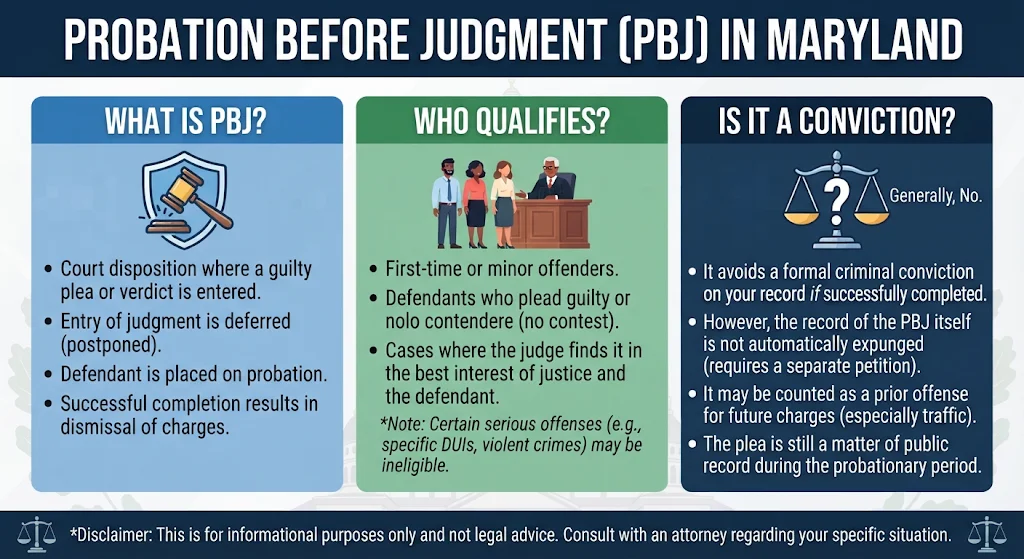
Short answer: Probation before judgment, or PBJ, lets a Maryland judge place you on probation without entering a judgment of conviction. If you finish probation successfully, Maryland law treats the case as closed without a conviction. That is not the whole story, though. Federal immigration law, some licensing rules, and certain DUI consequences can treat a PBJ very differently.
What Is Probation Before Judgment in Maryland?
PBJ is a disposition under Maryland Criminal Procedure § 6-220. After a guilty plea or a guilty finding, the judge can stay the entry of judgment, pause the case, and place you on probation. The court is not required to grant it, and you must agree to it.
Think of it as a conditional pause. The judge holds the final result in reserve while you complete conditions such as:
- Reporting to a probation agent, or unsupervised probation in some cases
- Paying fines, costs, or restitution
- Completing classes, treatment, or community service
- Staying away from new arrests
If you complete everything, the court discharges you from probation. That discharge is entered without a judgment of conviction. If you violate probation, the judge can enter a guilty judgment and sentence you.
The Two Types of PBJ: Standard and PBJ (c)
Many articles describe only one kind of PBJ. Maryland now has two.
Standard PBJ under § 6-220(b). This is the traditional version most people know. It is not a conviction under Maryland law, but it can still count as a conviction under federal immigration law.
PBJ (c) under § 6-220(c). Maryland created this newer version in an effort to reduce immigration harm. It uses a written agreement with the court, and the defendant gives up the right to a trial in exchange for a withheld finding of guilt. Because it is relatively new, how federal immigration authorities and courts will treat it is still developing. Do not assume it is a guaranteed shield.
If you are not a U.S. citizen, which version you receive may matter more than the outcome itself. Raise it with your lawyer before you agree to anything.
Is a PBJ a Conviction in Maryland?
Under Maryland law, a successfully completed PBJ is not a conviction. The statute says the discharge is without judgment of conviction and that you should not face the legal disabilities that normally follow a conviction.
The practical reality is more layered. Whether a PBJ “counts” depends on who is asking and why:
- Maryland courts: generally no, once probation is completed
- Federal immigration authorities: often yes for a standard PBJ, because federal law defines conviction differently
- DUI and traffic cases: a PBJ can still be treated as a prior offense for penalty and licensing purposes
- Employers and licensing boards: it depends on the question asked, and a PBJ may still appear on a background check until the record is expunged
The safest mindset is this: a PBJ is a strong result in state court, but it is not a clean slate until you have checked every area of your life where it could matter.
Who Qualifies for PBJ in Maryland?
There is no automatic eligibility list. A judge decides case by case. Factors that tend to matter include:
- Whether this is your first offense or you have a prior record
- The seriousness of the charge and any harm to a victim
- Whether a victim or the State’s Attorney objects
- Your work, family, and community history
- Whether you are willing to complete conditions such as treatment or restitution
PBJ is commonly seen in lower level cases such as many misdemeanors, theft matters, and some drug or assault cases. Some offenses carry statutory conditions, and prior PBJs can limit what a judge may do. Serious violent offenses are far less likely to resolve this way.
Can You Expunge a PBJ in Maryland?
Often, yes. A PBJ is one of the dispositions that can be expunged, which is a major reason people value it. As a general rule, you must wait until the probation period is over or three years have passed, whichever is longer. Certain DUI related PBJs carry a much longer waiting period.
Two cautions:
- A new conviction during the waiting period can block expungement of the earlier case.
- Expunged records can still be accessible to some agencies for limited purposes, such as certain security clearances and licensing reviews.
What Makes This Guide Different: A “Before You Say Yes” Checklist
Most people hear “no conviction” and accept immediately. Pause and run through these questions first.
- Citizenship status. Are you a green card holder, visa holder, or undocumented? If you are not a citizen, ask whether standard PBJ or PBJ (c) is even on the table, and whether another outcome is safer.
- Professional license. Nurses, teachers, lawyers, security guards, and commercial drivers often have reporting duties that go beyond a conviction.
- Type of charge. DUI, domestic violence, and firearm related cases have special rules that can follow you after PBJ.
- Probation length and conditions. A long probation with strict terms can create more risk than a short deal.
- Expungement timeline. Know exactly when you can file so you can plan around job applications and housing.
- Alternatives. Dismissal, stet, or a different plea structure may be better than PBJ in some situations.
Common Mistakes People Make With PBJ
- Assuming “not a conviction” applies everywhere. It does not.
- Violating probation over small things. Missed payments or skipped classes can turn a PBJ into a conviction.
- Forgetting to file for expungement. It does not happen automatically.
- Answering background questions incorrectly. Some applications ask about arrests or dispositions, not just convictions.
- Taking a deal without immigration advice. This is the costliest mistake.
Frequently Asked Questions
Is probation before judgment a guilty plea?
Often the process involves a guilty plea or a guilty finding, but the court then withholds entering judgment. If you complete probation, there is no conviction under Maryland law.
Does a PBJ show up on a background check?
It can, until the record is expunged. Many checks report arrests and dispositions, not only convictions.
Can a PBJ hurt my immigration case?
Yes. A standard PBJ can still be treated as a conviction under federal immigration law. PBJ (c) was designed to reduce this risk, but its treatment is still evolving, so get individual legal advice first.
How long does PBJ probation last?
The judge sets the length based on the case. It can be short or extend for years, and the term affects when you can seek expungement.
What happens if I violate PBJ probation?
The judge can enter a guilty judgment and impose a sentence, which may include jail time permitted by the offense.
Can I get more than one PBJ?
Maryland places limits on repeated PBJs, and a prior one can affect what a judge is willing to do. Ask your attorney how your history applies.
Is PBJ available for DUI?
Sometimes, but DUI related PBJs come with extra consequences, including how the case may be counted later, so they require careful review.
How soon can I expunge a PBJ?
Usually after probation ends or three years pass, whichever is later, with longer waits for certain DUI related cases.
Do I need a lawyer to get a PBJ?
The judge makes the decision, but an attorney can negotiate the structure of the deal, argue for eligibility, and check the immigration and licensing impact before you accept.
Final Thoughts
A PBJ can be one of the best outcomes in a Maryland criminal case, but only when you understand what it does and does not protect. The most important step is to review your personal risks, especially immigration, licensing, and DUI history, before you agree to the disposition.